
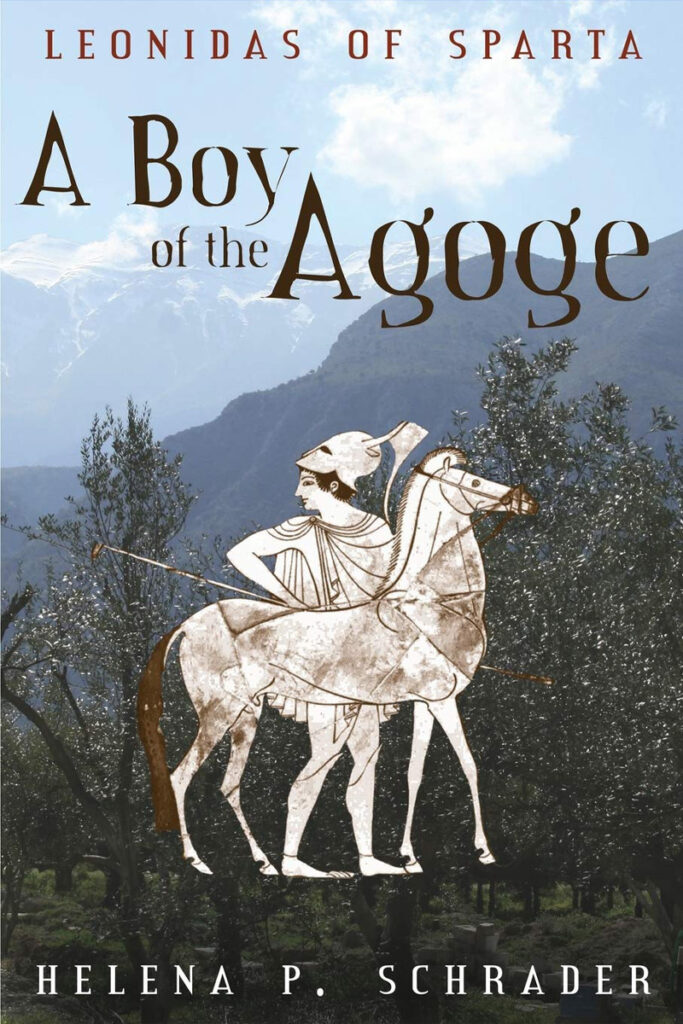
Book I of the Leonidas Trilogy: A Boy of the Agoge
Leonidas: The Hero of Thermopylae
In 480 BC he would defy an army half a million strong.
But who was Leonidas?
The smaller of twins, born long after two elder brothers, Leonidas was considered superfluous at birth. Lucky not to be killed for being undersized, he was raised not as a prince, but as an ordinary citizen. As such he had to endure the harsh upbringing of ordinary Spartan youth: the Agoge.
Barefoot, always a little hungry, and subject to rigid discipline, Leonidas must prove himself worthy of Spartan citizenship.
Reviews Excerpts
“This is a great read; Helena Schrader is a first class story teller with a deep historic knowledge of the period she writes of; she can certainly be placed in the same category as Mary Renault or Colleen McCullough. A very imaginative book while at the same time strictly adhering to historical facts.” JC de Uriarteon
“I couldn’t put it down. I love histotical fiction that makes a real attempt at accuracy and provides depth into the characters. This book used real facts whenever possible and filled the gaps with plausible fiction.” Macil Krieseron
“In Helena’s vision of Sparta people remain people, they feel and think like people would. … There is also A LOT of very good logic in Helena’s reconstruction of what an Agoge would be like. So, unlike some other historical works supposing the Agoge amounted to simply beating up little boys or constantly molesting them or forcing them to live in the wilderness on their own for unreasonable periods of time, the Agoge of Helena Schrader actually makes sense. In her view of Agoge, you can really see how little boys are taken gradually, year by year, to a new level of knowledge of themselves and the world around them, as they become more intellectually developed and physically fit and overall competent.” An Amazon Reviewer
“Professor Schrader gives us wonderful descriptions of what Sparta, itself, was like, what life there would have been like; the temples, the government, the lessons taught at the Agoge, early public schooling for girls, the dances, holidays and rituals, the wars and end relationship with Massenia. ..
[This is] not only an enjoyable read, but an educational one as well, especially for people interested in that period in history, of which I am one. her prose, spelling, punctuation? I found nothing that distracted me from the story itself. It flowed smoothly, without bumps, or hiccups, and at a nice steady pace. She did not race through the story, nor did she stumble upon any spots that mired the reader down. As I said, I sat through it in one, non-stop reading session.” Anthony Hargis
“The Spartans have almost always gotten a bad press, because their story has been told by (other Greek) writers, who thought their values and the discipline needed to instill and maintain them were somehow “un-Greek,” i.e., barbarian, and were horrendously scandalized by the independence and public presence of Spartan women.
“Ms Shrader has taken what is known about Sparta and Leonidas, applied some clear and scholarly thinking to it, and added a large dose of her own imaginative story-telling. The result both engages the reader and rehabilitates the reality of Sparta. For readers fond of high-quality historical fiction about the Greek and Roman world, and of books completely free of distracting historical and linguistic errors, don’t plan on reading anything else until you’ve finished this. Maybe not even until you’ve finished the other two books in the series!” M. Cotone
“Schrader humanizes Leonidas and his friends and her book reads as a fast paced story with a number of exciting adventures and misadventures. I was quickly drawn into the story and every page made me want to read more. I am looking forward to reading her other two books about Leonidas.” Robin E. Levin
The author’s writing quickly blossomed into a coming of age tale chock full of rich history and pieced together with a fruitful imagination. The characters are so wonderfully different and developed, one can’t help but be taken along for the ride. In short, I loved it!
I am currently in my second year of study for a Masters degree in Education and Literature. This book compliments my own studies of education, not just for its historical insight, but also for how well the author jives historical political issues with contemporary ones. We certainly can’t avoid being human, and it is clear the same problems within Spartan society still exist today. There are undertones in this book for the search for that ideal government and society, and how the cycle and fight for perfection is constantly brought to its knees by corruption, greed, and the occasional blind-eye. We, the reader, watch Spartan societies’ difficulties unfold through the perceptive eyes of Leonidas. He carefully observes what he sees in his own people and its policies, unsure and questioning at times as he learns from them and uses this information to shape his own identity and views.” D. Lebost